UK Gambling Statutory Levy
Who pays it, how much, where the money goes — and the honest answer to whether it has made your bonuses smaller.
For two decades the money that funded gambling research, prevention and treatment in Britain came from operators donating voluntarily. It worked in the sense that money arrived; it did not work in the sense that the amount was unpredictable, the biggest contributors could ask questions about where it went, and several operators contributed almost nothing at all.
The statutory levy replaced that. Since 6 April 2025 every holder of a Great Britain gambling licence pays a set percentage of its gross gambling yield, the Gambling Commission collects it, and government decides how it is allocated. This page sets out the rates, the calendar and the parts that genuinely affect people who play.
What the Rule Actually Says
The levy is charged on gross gambling yield — broadly, stakes received minus winnings paid out. It is not a tax on your stake and it is not deducted from a win. It is a charge on the operator's revenue, sitting alongside remote gaming duty and the Gambling Commission's own licence fees.
Crucially, it attaches to the licence rather than to the player. An operator with a Great Britain licence pays it on the GGY generated under that licence. An operator licensed somewhere else, serving the same customer from the same laptop, pays nothing into the scheme at all. That distinction matters more than the percentage does.
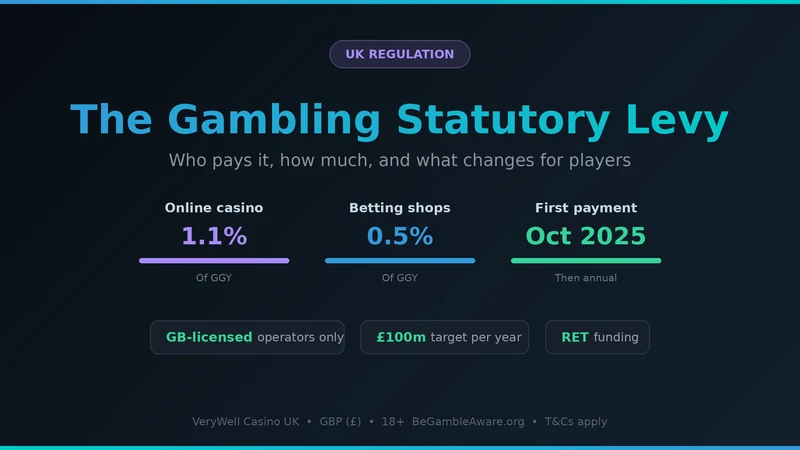
The stated purpose is to put research, prevention and treatment funding on a stable statutory footing, with government rather than industry directing where it goes. The scheme is designed to raise roughly £100 million a year across the whole licensed sector.
The Rates by Licence Type
The rates are tiered by activity, and the reasoning is that online gambling carries a higher risk profile and lower overheads than a high street shop. Whether you accept that reasoning or not, the numbers are the numbers.
| Licence type | Rate on GGY |
|---|---|
| Remote (online) casino, betting and bingo; gambling software | 1.1% |
| Land-based casinos and betting shops | 0.5% |
| Adult gaming centres, bingo premises, on-course bookmakers | 0.2% |
| Society lotteries and external lottery managers | 0.1% |
To put 1.1 per cent in perspective: on an online operator with £100 million of gross gambling yield it is £1.1 million a year. That is a real number for a mid-sized business and a rounding error for the largest, which is one of the criticisms levelled at a flat-percentage design.
Dates and Deadlines
Where the Money Goes
The levy funds three things, usually shortened to RPT: research, prevention and treatment. Government sets the proportions, which is the structural change — under the voluntary system the people writing the cheques had a great deal of influence over who cashed them, and that was the criticism the reform was built to answer.
The largest share goes to treatment, commissioned through the NHS in England with equivalent arrangements in Scotland and Wales, so that someone seeking help is referred into ordinary health services rather than into a charity funded by the industry that took their money. Prevention takes the next slice and covers education and early intervention. Research takes the smallest share, directed through the established research councils so that the evidence base is independent of both operators and campaigners.
Treatment
The biggest share. NHS-led services, free at the point of use, for people already experiencing harm.
Prevention
Education, awareness and early intervention — reaching people before a problem becomes a crisis.
Research
The smallest share, routed through independent research funders so that findings are not commissioned by the industry.
Whether £100 million a year is the right figure is genuinely contested. Public health researchers argue it is modest next to the scale of harm; operators argue that it lands hardest on smaller businesses that can least absorb it. Both positions have something to them, and neither changes the fact that the money is now collected on a schedule rather than requested politely.
What It Means If You Play
Nothing appears on your account. There is no line item, no deduction, no change to the odds or the return-to-player figure on a slot. In the narrow sense, the levy is invisible to players and the operators who told their customers otherwise were being unhelpful.
The indirect effect is real but easy to overstate. When an operator's cost base rises, the first budget to move is marketing, because it is the only genuinely flexible one. That shows up as a slightly smaller welcome offer, a tighter wagering multiple, a lower conversion cap or a promotion that quietly disappears. Anyone who has watched UK bonus terms over the last three years has seen exactly that drift.
But the levy is one of several pressures acting at once — affordability checks, stake limits, advertising restrictions and duty changes all pull in the same direction. Attributing a shrinking bonus to the levy alone is tidy and not really true. Our bonus page compares the current terms against the market and shows where the drift has landed.
The part that is genuinely good news: the money funds treatment services that are free at the point of use. If gambling has stopped being fun, the National Gambling Helpline is free and open around the clock on 0808 8020 133, and GamCare runs it.
Four Things People Get Wrong
"It is a tax on my winnings"
It is not. Gambling winnings are not taxed for players in the UK, and the levy is charged to the operator on its revenue. Nothing is withheld from a payout.
"Every casino pays it"
Only holders of a Great Britain licence. Offshore sites accepting UK customers under a foreign licence contribute nothing — which is worth remembering when comparing their promotions with a GB-licensed site's.
"It replaced GamStop and the affordability rules"
Different mechanisms entirely. The levy is a funding measure. Self-exclusion and financial risk assessments are player-protection measures that exist independently of it.
"Operators can choose who receives the money"
That was precisely the old system, and precisely what the levy was designed to end. Collection and direction now sit with the Gambling Commission and government.
A Short Checklist Before You Deposit Anywhere
The levy is a useful reminder that "licensed" is not one thing. Two minutes of checking tells you which protections you actually have.
- Find the licence statement in the site footer and note which regulator issued it.
- If it claims a Great Britain licence, confirm the operator name on the Commission's public register rather than trusting the badge.
- Check whether the site participates in GAMSTOP. Participation is mandatory for GB licensees and voluntary for nobody else.
- Note which dispute resolution body is named in the terms, and whether its decisions bind the operator.
- Set a deposit limit on day one. It is the single most effective control available and it takes about thirty seconds.
Where These Figures Come From
Everything on this page traces to primary sources rather than industry commentary. If a number here disagrees with one of these, the source wins and we will correct the page.
-
Gambling Commission — statutory gambling levy
The operational guidance: calculation periods, invoice and payment dates, and the £10 minimum.
-
Gambling Commission — public register
The only authoritative way to confirm that a site really holds the Great Britain licence it claims.
-
BeGambleAware
Free, confidential advice and the route into the treatment services the levy helps fund.
Statutory Levy Questions
What is the UK gambling statutory levy?
A compulsory charge on operators holding a Great Britain gambling licence, calculated as a percentage of their gross gambling yield. It replaced the voluntary donation system that funded research, prevention and treatment of gambling harm.
When did the statutory levy start?
The regulations came into force on 6 April 2025. The first invoices were issued on 1 September 2025 and had to be paid before 1 October 2025, and the same September-invoice, October-deadline cycle repeats each year.
How much is the levy?
Between 0.1 and 1.1 per cent of gross gambling yield depending on the licence type. Online operators and gambling software licences pay the top rate of 1.1 per cent; land-based casinos and betting shops pay 0.5 per cent; adult gaming centres, bingo premises and on-course bookmakers 0.2 per cent; society lotteries and external lottery managers 0.1 per cent.
Do players pay the levy?
Not directly. It is charged to the operator on its gross gambling yield, not added to your stake or deducted from your winnings. Where it shows up for players is indirectly, in slightly less generous promotions.
Who collects the money?
The Gambling Commission collects and administers it under direction from government, and it is then directed towards research, prevention and treatment. The scheme is expected to raise in the region of £100 million a year.
Does the levy apply to offshore casinos?
No. It attaches to the Great Britain licence, so an operator licensed elsewhere pays nothing into it — and its customers sit outside the Gambling Commission consumer protections that come with that licence.
Is there a minimum payment?
Yes. Where a licensee's total billable levy for the period comes to £10 or less, no payment is required.
Has the levy changed my bonus?
Indirectly, and along with several other cost pressures. Marketing budgets are the flexible part of an operator's cost base, so tighter wagering terms and lower conversion caps are the usual response.